Showing posts with label Artists. Show all posts

Sunday, March 8, 2009

Coup

Coup 1 by Samantha Zaza

On Saturday morning I discovered these fabulous paintings by the artist Samantha Zaza, who lives and works in Istanbul and is an Urban Sketcher. There are 16 paintings in the series and I am posting them here especially for the Grade 703 who recently completed a series of Pigeon Portraits.

Make sure that you click on the picture so that you can go and look at all the other portraits as well as explore the rest of Samantha's work. Enjoy.

A special thank you to Ms. Zaza for generously sharing her artwork with us.

Thursday, November 27, 2008

Cells 4

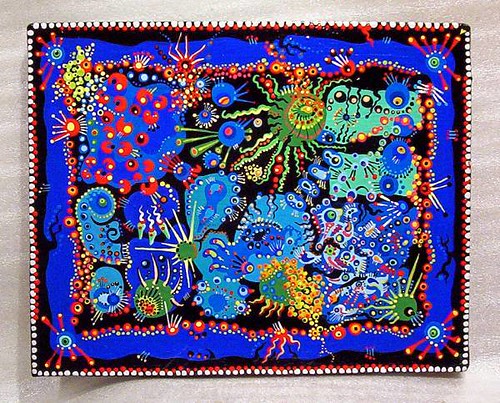
Grade 8, now that most of you have started your Cell projects and are beginning to paint, I want you to start thinking about what your final painting will look like. Here are some examples of Cell art to get you imagining the possibilities some more...


Madonna con Clon, Dr. Hunter O'Reilly


For homework, and to get you thinking about the Science of it all, visit these two links: Cell City and Cells Alive! Be ready in class next week to ANSWER QUESTIONS about the homework.

Remember that Mr. Young is going to be looking for the following information in your final painting:
  1. Name: The Cell is accurately named and sourced
  2. What is it: Kingdom of life the Cell belongs to is identified. Where in the multi cellular organism it is found is identified. If it is unicellular, where the organism lives.
  3. What does it do and how: Explanation of how it performs its function
  4. What makes it a Cell: 5 features common to all cells are identified
  5. What makes it unique: 5 features unique to this Kingdom of cells or this specialized cell

Friday, October 24, 2008

Rob Gonsalves: Real to Surreal


Grade 6, here is the link to the Rob Gonsalves slide-show (click on his name) that I was showing you in art class. Enjoy! Thank you Bade for sharing this with us.

Sunday, October 19, 2008

Urban Sketchers

Check out this link for Urban Sketchers.

"Urban Sketchers is a community of artists around the world who draw the people and places of the cities where they live and travel to. This blog is an extension to the Flickr
Urban Sketchers group started in November of 2007 by Seattle journalist and illustrator Gabi Campanario."

Sunday, October 12, 2008

Colour 2


Complementary Colours are the colours that are directly opposite each other on the Colour Wheel.


In art class this week you are going to make your own Complementary Colour chart for your Development Sketchbooks. While you are painting your chart you will probably notice how a colour and its complement seem to work very nicely side-by-side. You will also notice that the colours appear to be strong and might even feel like they vibrate when they are together. This is because when the two colours (red & green, blue & orange, yellow & purple) are together they seem brighter and more intense.

Your first painting assignment in Art this year is going to be a Complementary Colour painting. We will talk more about that in class. Right now you should note the colours in the painting called La Musique (Music) by Henri Matisse (1869-1964) ...


La Musique (1939)
by Henri Matisse

Thursday, September 25, 2008

Cells 2

How to set up your Cell Research in your Development Sketchbook
To start your cell research you will need to have the following elements in your Development Sketchbook. Remember to write everything in your own words.

  1. Write the date on the page (top-right-hand-corner).
  2. Give your page a title: Cell Research.
  3. Write an explanation of the assignment. For Example (do not copy this): We are studying cells in Biology and our first painting assignment in Art is to paint a large-format painting of a cell-structure. Ms. Lacoste has asked us to research three images of cell structure in our Development Sketchbooks. For the Art research we have to draw 2 of the cells twice, once just as a line drawing and the second time as a line drawing that we colour using Watercolour pencil. This assignment is to familiarize us with the structure of different cells as we learn about them and think about what our final painting will look like.
  4. Paste a minimum of 3 images into your books, label the type of cell they are and where you found the image, the source.
  5. Draw 2 of the cells two times. 1 line drawing + 1 Coloured for both cells = 4 sketches
  6. Create your own colour scheme for the cells you have drawn, do not copy the images you have downloaded, use them only as a reference.
  7. Remember to be creative in the way that you present your Research, use your pages well and think about the lay-out of your information. You want it to be interesting and fun to look at.

These images come from the work of David Goodsell who is a Molecular Biologist as well as an artist. I put them side-by-side so that you could compare the black and white line drawing to the coloured one.

Sunday, September 7, 2008

Sketchbooks


This year the only supply that you will need to buy is your Development Sketchbook.

On occasion throughout the year you might be asked to go and shop for a particular specialty item when we are working on various projects, but you will not need paint, pencils, brushes or paper - those will be provided in the classroom for you.

Your sketchbook should be A4 in size and bound, not spiral. IF you are continuing with your Development Sketchbook from last year (Grade 7 and Grade 8) then you do not need to buy a book.

We will talk in class this week about the books and I will show you examples of the type of book you should be looking for.

Meanwhile check out this link to Dan Hillier's website. He is an artist who has some examples of his own sketchbooks and they are amazing. Make sure you scroll through the pages.